Lady D
December 29, 2012, 9:54pm
Tom Shayes, an affable attorney was stabled in a rundown apartment. His attacker was gun down by a third man. With multiple knife wounds Shayes finds his way home, only to be drown by the man he tried to catch.
My phone rung. I almost jumped out of my bed. After a dinner party I went to bed early, was engrossed with the third season’s last episode of Glenn Close’s legal thriller Damages.
“Irene, Denise is dead.” Cate called.
So many characters died in the last episode, even Tom. I did not see that coming. I was slow to focus, extracting myself from the legal thriller.
“Irene, did you hear?”
“Sorry Cate, hi. How are you?”
A round of laughs from the boys playing down stairs.
“Irene, Denise just dead.” She repeated.
“What?”
“I said DS dead.”
“WHAT???”
I thought the call was a season end greeting but it’s a horrible news that no one wish to hear: the passing of a dear friend and fellow tennis bum.
Initially I didn’t quit grasp what she was saying.
Then she yelled,
“Irene, Denise is dead.”
That, really shocked me up.
I was numb for a brief moment then we resumed talking crying.
I regret that I was lazy, didn’t send out the email to arrange a dinner when Carina is coming to visit – her dad took Lady D and Sir L around in Beijing in November this year. And as if happens, Carina’s cousin works at the same company as Lady D .. a small world.
What other things I should have done but haven’t?

Tomorrow is not forever although most people think, at lease for me.
Tomorrow may not come.
Denise was so healthy and active, full of life .. I could not image that she’s no longer with us.
RIP Lady D, you’re missed.
With much love ..
more pix in gallery
NTRP means nothing to me but great deal to others. Denise had always wanted to be a 3.5. So I asked the league to award her a 3.5 posthumously. The league refused: “we have no way of doing it.”
The league takes the rating seriously.
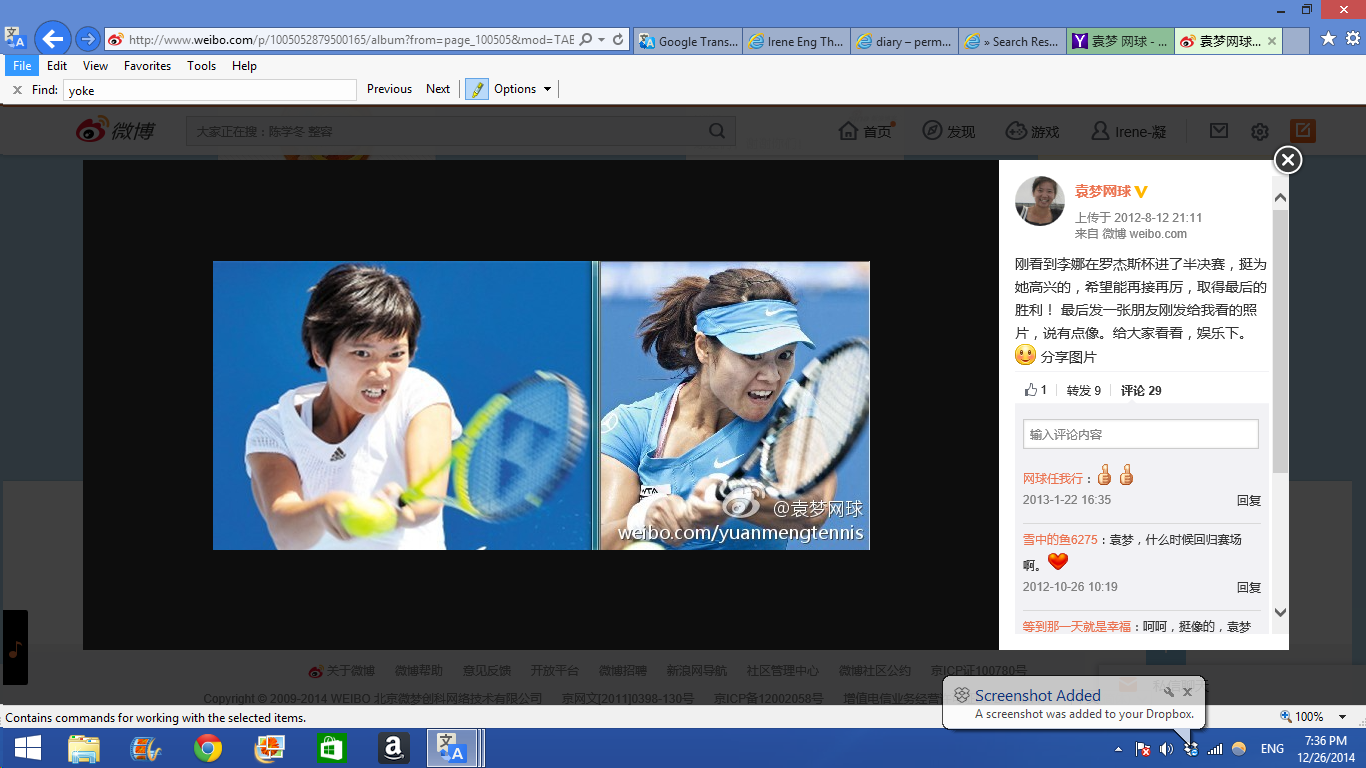
Stats
The season is mid way through, three divisions total points/games played:

Div 1-3, as of 12/25
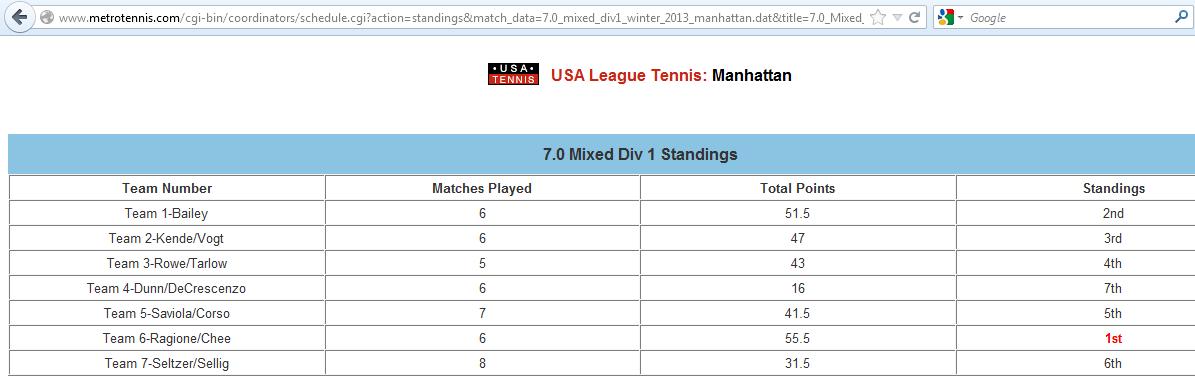
Div 1
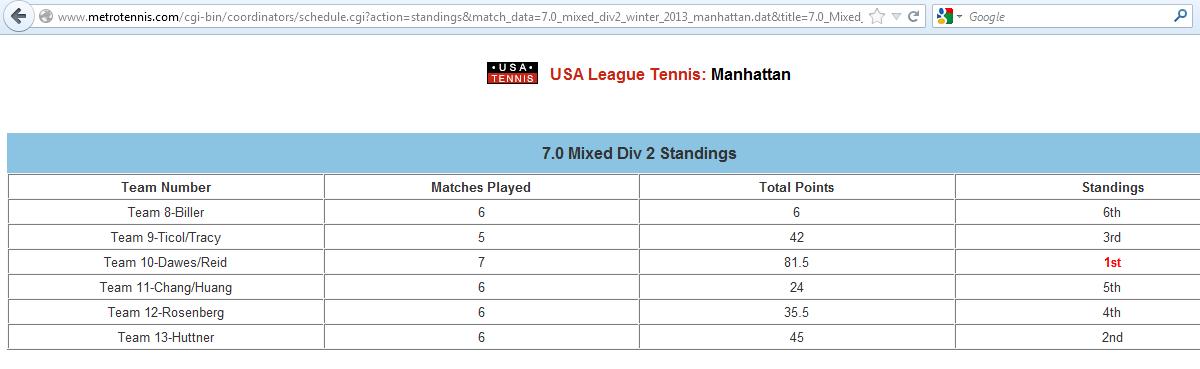
Div 2
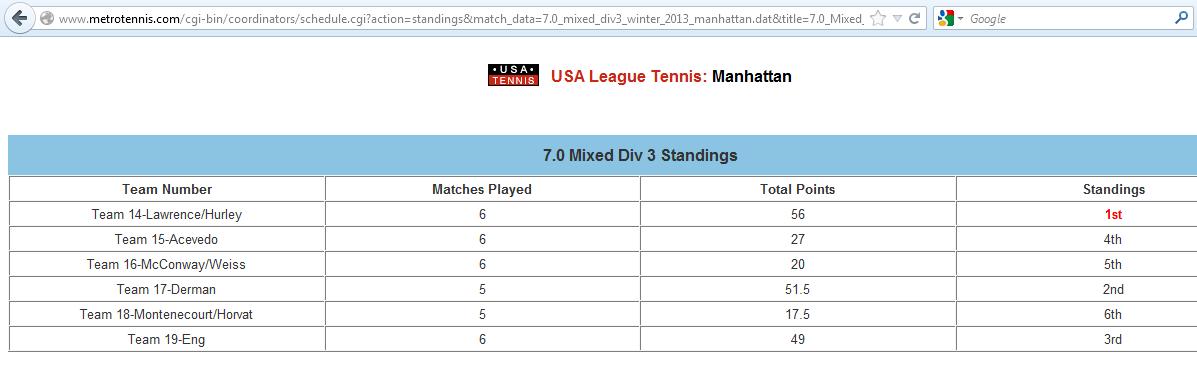
Div 3
The cost of tardiness
The 2013 season has just under way and I’ve already had one default due to late arrival, and couple of casual tardiness that resulted in heated and prolonged dialogs on and off the court. Being puncture is more or less controllable, and one way to ensure it, just leave early. Is this hard to achieve? I guess so.
The biggest casualty due to late has to be our Queens 2010 playoff when one of the Manhattan team’s girls was late. The coordinator default the match (and Kai/Anna who had the winiest record like, 22-1 sat out). The male player wasn’t charmed by this decision and argued, and argued, and argued loudly, telling Deb Rose to only default them a set .. .. until she told him to be quiet other wise she would default the entire team for unsportsmanlike conduct. Reportedly, the Manhattan team was so confident to capture the Metro championship they even made hotel reservation before all the matches were played.
The male player asking the coordinator to default them only a set was so absurd because the rule’s so clearly stated. He seemed like 狗急跳墙 cornered dog to me. Perhaps this showed how desperate he was, trying to salvage the match. Human nature? Probably but by being on time could avoid all of these.
- The very first: women’s 3.5, June 15, 2012
- Her first match, Dec 13, 2012
- Redo the line up, Dec 18, 2012
- Late again, Dec 23, 2012
- Other problems
Late again
One of our teammates was running late. The opposing team has a player came late too: the two actually spoke (asking direction) on the way to the club.
Three courts were very competitive. However, we lost 1D to a default despite of leading 9-6 in the tie break, over a line call dispute.
She said:
During the tiebreak, the player from Great Neck hit a ball, which was audibly called wide by our male player.The Great Neck team countered that an “in signal” had been made by our female player, which both players from our team immediately said was not the case. Our female player had to jump out of the way of the ball and explained that she was unable to make any call because while in mid air was unable to see where the ball had landed and had deferred to the player that was watching the spot of the ball.
He said:
Giselle and I were at the net and Giselle hit a volley very wide. The ball takes a funny bounce on the line, the guy calls it out and the girl misses the ball. I was watching her and the line and she immediately gives a flat palm signalling good. The guy becomes very loud arguing that he called it out. Nobody was disputing him but the girl then changes her mind and said he called it out. If she had called it out immediately then I would have moved on to serve again for match point.
The rule: All line calls must be made clearly and immediately. If there is any doubt, the ball is good. (A ball that is 99% out, is still 100% in).Hmmmm … was unable to see where the ball had landed .. hmmmmm …
The coordinator awarded the match to our opponent. Back to more problems
2013 Queens Mixed Rules
18 & Over Mixed Doubles Local Rules:
- Registration fees on TennisLink are $33. This is in addition to USTA Membership.
- Team Match Fees: $33 per player per match
- Registration deadline: 1 March 2013
- All fees must be paid in full by 1 February 2013 (USTA League Tennis -> XXXX League -> Pay for matches)
- Teams will pay a $150 per match fee for all District playoff matches before the match time. Failure to pay the fee before match time may result in the team’s forfeiture.
- Divisions of 4-7 teams (each team plays every other team in their flight a minimum of two times during the regular season) will send the top two teams to playoffs.
- Tentative Playoff Dates: The playoff schedule is determined at the sole discretion of the league coordinator and may be altered. Teams will be notified of the exact dates once they are finalized.
- District playoffs: tbd – April (National Tennis Center)
- Regional Playoffs: May (National Tennis Center)
- Eastern Section Championships : May 31 – June 2, 2013 in Schenectady
- National 18 & Over Mixed Doubles: tbd
Miscommunication: late arrival
It was the middle of December 2012, and we were playing in the middle of our three month and ten matches long season.
It’s Pumpkin’s freshman year in college who gets home in a record time from school and we decide to take in The Hobbit: An Unexpected Journey. I thought they’d like 3D (at 7:00 pm) but they prefer 2D (6:30 pm). It isn’t my type of movie but I tried to glue to the seat, to be there with them. However, mid way into the adventure, my phone begins to shake: emails, texts and voice calls pouring in like broken dam, unstoppable.
All from my teammates: one of my First Doubles players is late.
Getting a call right before a match, is like a phone rings in the middle of the night: nothing but nightmare.
- The First Chauffeur is texting: where to pick up our two teammates
- The acting captain is calling because the opposing captain asked him to move our 1D to 3D due to lateness.
- The Second Chauffeur is texting and calling ..
Because the match is held at the bubble which is a good 5-10 minutes walk from the main building, in the dark so I asked one of my mates who drives to pick up the two mates who take subway. I just could not bear the thought that they walk in the dark. (Not sure if the Metro league knew/cared, they should really not to schedule matches, especially for the Manhattan league in the bubble.) When Mr. First didn’t respond I asked Mr. Second. Now Mr. Second is risking being late too. When they finally get hold of everyone, it’s obvious that 1D will be good 10 minutes late.
By the way, it’s an violation to use any electronic device on court – may constitute coaching! The Metro league credits each court with the following number system:
1D = 6 points
2D = 4
3D = 3
Obviously 1D worth twice as many points as the 3D. Moving my 1D to 3D, the opposing team, presumably has a clear advantage on paper. I am furious. In my past experience, we just waited till the opposing team’s player(s) to show up. I’ve never asked them to switch the line up – the thought has never occurred to me because it isn’t a decent thing to do. I want to win fair and square.
Time is ticking.
I exit the movie twice to handle the situation. My acting captain finally give up arguing and says that he keeps telling the opposing captain that the missing player will arrive before the cut off time. He says he’ll do whatever the opposing captain wishes because the short 1.5 hour is diminishing very fast.
12 minutes pass the starting time, my running late mate steps on to the court. Match starts.
The movie (2:46) ends at around 9:15. My daughter asks me if I felt asleep.
Yes I did a little. It isn’t my cup of tea, and my mind was on the team.
They ask why did I have to go out, twice.
I went to the bathroom, I fabricate.
My kids enjoy it very much.
I feel sorry that my mates have to face so much chaos and stress. I call as soon as the pendulum strikes 10.
My 2D reports: we won.
Then my acting skipper says simply: we swept.
I am so pleased. No pleased isn’t the right word. Vindicated? Relief?
As I’m on the phone, I hear a woman’s voice screaming in the background, clear enough to make out that she’s going to appeal.
Appeal of what? My team did exact what you wanted them to do.
痛打落水狗 is never my style. But I’d like to know if the opposing captain has the right to force my team to switch. The flight coordinator replies:
You are supposed to exchange scorecards 5 min before the match and if all the players have not arrived yet then the missing player should be moved to 3D (in case of a default). That is in the rules too. Your opposing captain is correct.
A seasoned captain weights in:
It clearly states that a default must occur from the bottom up (3rd dbls first everyone else moves up), but only after the end of the warm-up period. It also states elsewhere that the warm-up period can be 15 minutes. Since the player showed up in 12 minutes, no movement was required. The fact that you did was quite gracious.
The rule on page 3 says:
Default: when player listed on the scorecard fails to show within 15 minutes after the match time.* Players arriving onto the assigned court more than 15 minutes after the match start time may be defaulted at the discretion of the opposing captain (having been so advised before the start of match play on that court.)
..
Scorecards must be exchanged simultaneously between captains AT LEAST 5 minutes prior to the match start time. Teams must present a line up at this time, even if all players are not yet present**.**Defaults MUST occur from the bottom up. If a doubles player is missing at the end of the warm-up, the line-up MUST be adjusted and that team put into the 3rd doubles position. The 2nd and 3rd doubles teams will be moved up 1 position – no other changes in either teams’ line-up are allowed. 3rd doubles MUST be the court defaulted.
The rule indicates only when 15 minutes of default time reaches. There is no rule to support when a player arrives late but within 15 minutes.
The way I read this the switch doesn’t occur until the 15 minute default time has lapsed. Therefore if a player (in the 1st or 2nd position) is late on either team, none of the matches should start until the default deadline is reached to accommodate the switch.
The coordinator writes back:
Irene,
Please read the footnote…it says that the default must occur in 3rd doubles. So most captains make the adjustment before the warm up if their player is missing. It’s just easier than having to interrupt the matches, does that make sense?Since your captain didn’t know the rules then the courts stand as they were played last night.
Few more emails exchanged. Finally, on 12/20 the coordinator admits:
Bottom line is (and this is what the majority of captains put into practice when interpreting the rule) if you don’t know where your player is – you should move them. If you are sure they are arriving on time – then leave the line-up as is and take the risk.
The arriving on time should change to arriving within 15 minutes.
Miscommunication? Maybe.
Arrive late? Inexcusable.
How’s the movie? What movie?
The Politicization of Jeremy Lin
By Albert Chan
THERE’S SOMETHING FOR EVERYONE IN THE YEAR’S BEST UNDERDOG STORY, THE POINT GUARD WHO CAME OUT OF NOWHERE. THE PROBLEM IS, PEOPLE EVERYWHERE WANT TO CLAIM THE SUDDEN GLOBAL CELEBRITY AS THEIR OWN
On a sweltering August afternoon in Taipei, in a crowded room that felt like a sauna inside a glittery shopping plaza, Jeremy Lin sat down on a couch, wedged between two billboard-sized images of his face, for a press conference. He was wearing a gray Nike T-shirt, blue jeans and sparkling white sneakers. He appeared rested and relaxed.
This was surprising, because if there were an athlete who had every reason to look haggard, it would have been Lin. Over two weeks last winter he had gone from nobody Knicks bench warmer to global sensation–one of the most discussed, heavily scrutinized athletes on earth. Lin would later admit that his first off-season as a celebrity was at times exhausting. It began with draining contract negotiations that rekindled questions about his worthiness as an NBA point guard; after he signed a three-year, $25.1 million deal with the Rockets that the Knicks, in a move that stunned the legions of Lin fans in New York City, chose not to match, Carmelo Anthony called his former teammate’s new contract “ridiculous.”
The signing was followed by an Asian publicity tour that took him from the U.S. to Taipei to Beijing to Shanghai and, later in the summer, back to Taipei. As celebrated as the Lin phenomenon was in the U.S., it was always bigger in Asia; at every stop in Taiwan and China, he was greeted by adoring crowds, often in the thousands. In Taipei, camera trucks, parked outside his hotel during his entire stay, filled a city block. Says a Taiwanese reporter, “He’s a cross between Bill Clinton and Justin Bieber here.”
At this press conference in the wealthy Xinyi district, with Lin’s parents and younger brother sitting in the front row, the mood was playful and loose. “Because your background is with economics,” asked one of the 300 reporters, referring to Lin’s Harvard degree, “and our economy is in a very bad situation–can you give us some solutions to save our economy?” (Lin: “Um I’m probably not the one you should ask.”)
Previously, a reporter had asked if he had a girlfriend. “That’s always my first question I get here in Taiwan,” Lin said. “When I find a girlfriend, I’ll e-mail all you guys and let you know.” Everyone in the room laughed.
About 20 minutes into the session, a newspaper writer stood up. “There’s now a huge debate about your nationality, and who you belong to–whether you belong to Americans or Taiwanese or Chinese,” she said. “What’s your view?”
The room grew tense. The question cut to the heart of the strange complexity of the Jeremy Lin Story: Here was a young American, Ivy League–educated, born and raised in the U.S. suburbs, being embraced in his parents’ homeland as a national hero. At the same time he was being portrayed in China as a symbol of strength for an ascending global superpower that for decades has sought to crush Taiwan’s independence. A basketball player from Palo Alto, two weeks shy of his 24th birthday, was caught in the middle of a decades-old conflict between two countries on the brink of war–and now he was being asked to pick a side.
“I think you guys know my family history,” Lin said. “I have great-grandparents and grandparents who were born and raised in China. My parents were born and raised in Taiwan. And I was born and raised in America. There’s a lot of history behind who I am.”
As a translator repeated his answer in Mandarin, and cameras around him flashed, Lin picked up a tissue and wiped the perspiration on his face.
The Linsanity may be over, but the war over Jeremy Lin has just begun.
Deep in the heart of Texas, nine months after the height of the Lin phenomenon–when everyone from President Obama to Sarah Palin to Saturday Night Live had something to say about him–this is what awaits Lin after a game: two dozen deadline-fretting reporters and cameramen, jockeying for position at his locker, waiting for him to shower so they can hear what he has to say. Never mind that it is the middle of November, not exactly crunch time on the NBA calendar, and Lin has had an entirely forgettable night (four points, four assists). A handful of other Rockets who had far more impact on the 100–96 victory over the Hornets sit unbothered nearby.
Lin’s time with the Rockets has been rocky: He is still struggling to mesh with new backcourtmate James Harden and at week’s end was averaging just 9.9 points and 6.1 assists while shooting 38.1%. He did have a chance to give Houston fans a taste of Linsanity in early November, when he hoisted a potential game-winning three-pointer with under 10 seconds left and the Rockets trailing the Heat by one. It was an air ball.
The questions after the New Orleans game dance around his struggles. “What do you think about your shooting?” asks a reporter from a Chinese newspaper. Asks another, “So, before the game, coach Kelvin [Sampson] said you’re working on going to your left? How is that going?”
After the group breaks up, two reporters from newspapers in Taiwan linger to tell Lin that they’ll be on a flight back to Taipei in the morning. Lin, as always, is friendly and disarming–he looks genuinely appreciative that they have come so far to cover him. “Have a safe flight,” he says. “Thank you, and see you again soon.”
One of the writers is from a popular Taiwan tabloid, Apple Daily, who has covered Lin since he was a rookie with the Warriors in 2010–11. After three weeks in Houston, Dennis Tsai is headed home to Taipei to see his wife and young son. Though the job takes you 8,000 miles from home, sometimes for months at a time, the Jeremy Lin beat has become the most coveted in Taiwanese and Chinese sports media. Lin is front-page news when he scores in double digits whether his team wins or not. Nearly every Rockets game is shown on one of the three Taiwanese sports channels; last season one network expanded its pregame show from 10 minutes to a full hour to satisfy the swelling interest.
“Jeremy Lin is a national hero in Taiwan,” says Tsai. “[Former Yankees pitcher] Chien-Ming Wang is considered the most famous and popular athlete in Taiwanese history. But Lin is already as big as Wang was–maybe bigger.” When he is in Taiwan, Tsai regularly takes his son to a recreation center to shoot hoops. After Linsanity he says the crowds there “tripled, because everyone suddenly wants their kids to play basketball. They think basketball is a ticket to Harvard.”
He adds, “The surprising thing is how all the women in Taiwan responded to Linsanity. Young girls see Jeremy Lin as their older brother. Older girls see him as their future boyfriend. Moms see him as their son. My mom, who never cared about basketball, sees him as her son!”
In the dense neighborhoods of Taipei, “you’ll see the basketball courts crowded with kids wearing Jeremy Lin jerseys,” says Blackie Chen, a former player on the Taiwanese national team and now a popular TV host. “You see the style [of play] changing too. In the past it was all one-on-one isolation. Now they pass the ball–the pick-and-roll is cool now, because of Linsanity.” Chen, who tried unsuccessfully to persuade Lin to play for the Taiwanese national team last year, believes basketball may now overtake baseball as the nation’s most popular sport.
On an island roughly the size of Maryland, Lin has become a figure of pride for a country that has fought for a place on the international stage since it broke from China in 1949 and that struggles for economic and political viability. Many in Taiwan are so enamored of Lin that they are oblivious to the fact that he is American-born. At a junior high school in Taipei, students were asked last spring if Lin was American or Taiwanese. Half said he was born in their country.
Last February, Eni Faleomavaega, American Samoa’s representative in Congress, met with Taiwanese president Ma Ying-Jeou at the presidential palace in Taipei to discuss the escalating tensions between Taiwan and China. Ma spoke about how Taiwan and the U.S. shared similar values and views on democracy, then added, “And we both appreciate Jeremy Lin.” Faleomavaega stopped him short. “I’m sorry to tell you,” he said, “Jeremy Lin is American. A full-blooded born American who happens to be of Taiwanese ancestry. And we’re very proud of him.”
All Ma could do was laugh.
The politicization of Jeremy Lin was inevitable. “Successful minority athletes always get racially drafted, made into symbols of achievement or excellence or striving for whatever group they belong with,” says Orin Starn, a Duke cultural anthropology professor and author of The Passion of Tiger Woods. “The exact same thing is happening to Jeremy Lin. He’s made into this symbol of Asia and its emergence–even though he’s a generic, suburban American kid.”
Overnight, Lin became many things to many people in the U.S.: the Savior of the Knicks, a basketball hero in a city starved for one; a Harvard Man who glamorized Ivy League hoops; a Man of Faith, a devout Christian and the NBA’s answer to Tim Tebow; an Inspiring Underdog who gave hope to against-all-odds ballers everywhere; an Asian-American Trailblazer who shattered math-science nerd stereotypes.
It took some time, though, for the phenomenon to catch on in China, where Lin presented a problem for the government. The Taiwanese flag–an image banned from Chinese media–was being waved at nearly every Knicks game as Lin, who had never started a game before before joining New York last December, revived an injury-depleted team and led it to victory after improbable victory. Lin’s religion was also an issue; Christians in China are a persecuted minority. At the height of Linsanity, on the night in February when Lin drained a three at the buzzer to beat the Raptors, CCTV, China’s state-run network, was showing a taped Champions League soccer match instead of the Knicks. “At first [China was] behind the story because of the political issues that CCTV had to deal with,” says Cai Wei, editor of the basketball magazine SLAM China in Beijing. “People just watched his games online. But then he just got way too big to ignore.”
For years China has been hungering for the next Yao Ming. After the hugely disappointing NBA careers of Wang Zhizhi and Yi Jianlian, Lin was the player Chinese fans were waiting for: someone new of Chinese heritage to represent the country in the world’s best basketball league. Lin was also a player fans could relate to; he wasn’t a Yao-like giant but a 6’3″ 200-pounder who, by comparison, would not look completely out of place in the streets of Beijing. “No one expected a Chinese point guard who could actually play in the NBA,” says Cai, who notes that Allen Iverson remains one of the most popular athletes in China.
One day this spring Cai walked into a bookstore in Beijing and counted the unauthorized Jeremy Lin biographies and magazine special issues on the stands. He found more than 100. Lin’s wild popularity in China–he has three million followers on the Chinese social networking site Sina Weibo (three times as many as he has on Twitter)–extends beyond the country’s desire for an NBA star. “We’re looking for any positive figure to represent the Chinese [in the West],” says Wei. “Who do we have? Jackie Chan? Jet Li? Lin is someone everyone, not just sports fans, can be proud of.”
While Lin’s father’s family has been in Taiwan since the 1700s, his maternal grandparents are from a small village in the eastern Chinese province of Zhejiang. As Linsanity grew last spring, Chinese newspapers began referring to him as the Pride of Zhejiang. An article in the Xinhua News–the official press agency of the government–called for Lin to play for the Chinese national team. lin looks like he just might start the war between china and taiwan, read a headline of one the countless online threads devoted to Lin’s roots.
“While Jeremy Lin is a big point of reference for identity politics in Taiwan,” says Shelley Rigger, a political science professor at Davidson, “this is also about China’s soft power campaign. It’s about the inability of the People’s Republic of China to make itself attractive to the world. The problem is, people don’t like it when you try to appropriate other people’s national heroes and turn them into your national heroes.”
Battles between Taiwan and China over international celebrities are nothing new: Both countries have claimed Taiwanese-born film director Ang Lee as their own, and in 2010, golfer Yani Tseng, who was born in Taiwan and is now ranked No. 1 in the world, was offered a $25 million endorsement deal by a Chinese company on the condition that she change her citizenship. (She declined.) Lin’s endorsement portfolio includes deals with Chinese-owned Volvo and KFC China. Maxxis, a Taiwanese tire company, sponsors the Rockets. Lin and his family have taken a diplomatic tack in the Chinese-Taiwanese debate: In order to avoid offending fans (and, perhaps, sponsors) in both countries, they have gone to great lengths to avoid the topic. “This has become a competition,” says Rigger. “The Taiwanese feel their invisibility in a huge way. The shadow of China has gotten so large. With Jeremy Lin, that started to change.”
In mid-November, the morning after that win over the Hornets at the Toyota Center–it was Jeremy Lin Bobblehead Night, and fans wearing his number 7 jersey were out in full force–I met Lin in the tunnel outside Houston’s locker room. He talked about his trips to Taipei this summer (“It was awesome; I always have such a good time there”) and how he misses the days when he could wander the city anonymously. “I love the night markets there–the food is so good,” he said. “The energy is so amazing. I really wanted to go out more. But I just couldn’t. It was so crazy.”
I mentioned that my parents are from Taiwan and, like his, immigrated to the U.S. some 40 years ago. I hadn’t lived in Taiwan and was far from fluent in Chinese or Taiwanese, and I never was comfortable with labeling myself as Asian-American, or Taiwanese-American, or Chinese-American. Still, I feel a deep connection to my parents’ birth country. Perhaps he felt the same way? “I definitely have strong ties to Taiwan,” Lin said. “I have a ton of cousins there, and every time I go back, I feel this connection to this place where my parents came from.” He added, “And I feel the same way about China because my grandparents came from there. When I went to China [in 2011], I went to the village where my grandmother grew up, and that was an amazing experience.”
I asked Lin how he views the controversy in the two Asian nations that claim him. “I know it’s a very complicated question,” he said. “And I understand where the hostility comes from and why it is the way it is. I just try to stay out of all that stuff.”
In the end, what Lin considers himself to be is irrelevant in the Jeremy Lin Story. He knows this: He long ago accepted his role as a symbol for the people–wherever those people are and whatever they want him to be. “When he was at Harvard, being Asian-American was a burden,” says Jessica Kung, a reporter for Taiwan’s China Television Company who has covered Lin since his college years. “He used to say that his goal wasn’t being a good role model, but being a good basketball player. But now he embraces being a role model.”
More and more, he is just Jeremy Lin, Point Guard–though there are still reminders that he’s not just another NBA player. Two weeks ago the Petition and Appeals Committee of Taiwan’s government rejected an application for the establishment of a political party named after Lin. “There will always be this battle over him, but I don’t think it matters what color you are or what country you’re from–I think he’s a role model for all Asians, and for everyone who’s suffered stereotypes,” says Kung. “I think he will get to a point where his story is beyond race–where he transcends it.”
Back in the Toyota Center tunnel, Lin puts forth a simpler goal. “I don’t see myself as an ambassador or as someone that stands for something,” he says. “All I want to do is make everyone proud.”
To the Taiwanese, Lin is seen as a “cross between Bill Clinton and Justin Bieber.”
“No one expected a Chinese point guard who could actually play in the NBA,” says Cai.
“J don’t see myself as an ambassador,” Lin says. “All I want to do is make everyone proud.”
IF YOU CAN MAKE IT THERE Lin has yet to replicate his New York success in Houston, where he has struggled to find his groove in the offense.
FEEDING THE BEAST Since his emergence last winter, Lin has been trailed by dozens of reporters who meet the demand for updates in Taiwan and China.
PEOPLE’S CHOICE At first many Knicks fans couldn’t understand why the team let Lin walk, though New York’s 15–5 start has made his absence forgivable.
SYMBOL CRASH In college Lin chafed at having to be more than just a player, but in the NBA he has accepted his status as a role model to divergent groups.
