By Daniel Kaplan, Staff Writer
Published August 26, 2013
It’s been a roller-coaster 12 months for the U.S. Tennis Association, owner of the lucrative U.S. Open starting this week, and the governing body of tennis in America.
There have been big wins, like the announcement two weeks ago of a long-awaited roof plan for the main stadiums, and in May a record-setting TV deal with ESPN.


But 12 months ago player discontent roiled the Open, which ended with a rain-delayed men’s final, the fifth straight one.
Then, responding to player demands for significantly more prize money, the USTA in December announced that the 2013 purse would be far below what the players were demanding.
Yet less than 100 days later, under what sources said were realistic threats of a player walkout, the USTA reversed course and indeed said it would handsomely hike prize money, despite avowals never to do so because it would threaten the group’s core mission of promoting tennis in the United States.
That was not the only setback on the professional side. After moving to reject claims by a group of officials seeking class-action status for back pay, a federal judge so far has ignored the USTA’s legal pleas to even allow it to file a motion to dismiss the case.
On the grassroots front, the USTA’s costly effort to remake how the game is played for children 10 and younger has engendered resistance from critics who contend that the so-called “Quickstart” tennis is ruining the game and will ultimately hurt the emergence of American pros.
The following stories look at the main issues confronting the USTA, including prize money, grassroots, venue development and a class-action lawsuit by referees.
Change of heart on prize money
The ATP led the charge on prize money increases at the Grand Slams, which based on a percentage of revenue, had dramatically underpaid athletes compared with other sports. And none more so than the U.S. Open because it has the top revenue in the sport.
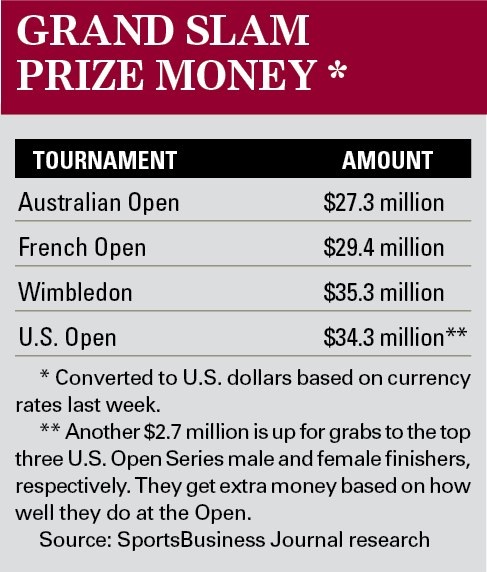
In December, the Open announced a modest increase in prize money to $29.5 million, yet three months later, the
event pivoted and said prize money would reach $34 million, with commitments to grandiose increases in the future.
A few developments happened in the interim period, including the Australian Open meeting player demands for higher purses. But the U.S. Open, because of its long schedule, rain delays and overt commercialization, had particularly drawn the players’ ire. Several key sources said the ATP had let the USTA know that players were willing to play a new, alternate event if the Open continued to resist serious prize money increases.
Gordon Smith, USTA executive director, said no such threats were made, but he did concede that the USTA had concerns about a player walkout in the future. With the USTA now in the market for up to a half-billion dollars in financing for venue renovations, Smith explained, the USTA did not want lenders spooked by potential labor strife.
“Someone looking at long-term financing wants to know whether we have stable arrangements going forward,” Smith explained.
The USTA had long taken the stance that the player demands would defund grassroots programs and stifle American tennis growth. Now, apparently the USTA can pay the players more and keep funding tennis programs.
Finally raising the roof
The USTA is self-financing a $550 million remake of the Billie Jean King National Tennis Center, which while at the forefront of tennis facilities when renovated in the 1990s, has fallen behind not just other Grand Slams but other tennis events like the BNP Paribas Open in Indian Wells, Calif.
Rain tormented the U.S. Open for five straight campaigns, aging stadiums are showing their wrinkles, and the layout of the grounds is not accommodating to the now 700,000-plus fans who stream through a fortnight.
By 2018, there are set to be roofs over Arthur Ashe Stadium and a new Louis Armstrong, with a third stadium relocated to the other side of the campus to reduce congestion on the grounds.
That should allow the number of fans to rise from 40,000 to 50,000 for day sessions, cementing the event’s claim to the highest annually attended sporting event in the world. Perhaps most importantly, at least for USTA public relations, is they no longer will have to await the questions about roofs during the next rain delay.
A slow embrace for Quickstart?
Over the last four years, the USTA has ushered in a virtual revolution in how the game is taught to children younger
Quickstart uses soft, foam balls and smaller courts to give children 10 and younger a taste of tennis. Critics, however, say the program dumbs down the game and hurts the sport’s growth.
Photo by: USTA
than 10 by literally inventing a new sport for them to play. Soft foam balls, tiny courts and nets are the result of a new business driven by tens of millions of dollars in investment by the USTA.
The idea of what is branded Quickstart is that children get frustrated by the game and leave in droves. Quickstart is not without its critics, however. In fact, many believe the USTA is retarding the growth of the sport, especially for future professionals.
“By getting tennis to be the fastest-growing sport, they have dumbed it down, which makes it challenging for some to attempt to be elite,” said Rob Castorri, who runs Ivan Lendl’s tennis academy in South Carolina. “They have overlooked a major component of what makes a competitor, and doing what they are doing, I don’t see an American player coming along that will dominate.”
Castorri’s and others’ critiques are severalfold. First, Quickstart is a one-size-fits-all approach that requires kids younger than 10 to play, whether they are ready to move up or not. Castorri believes by the time children are 6 or 7, it’s time to move them to the full court.
And by making the game easy (some Quickstart sessions start out with kids hitting balloons with rackets) it actually loses kids who grow frustrated with its simplicity, the critics contend. The USTA’s requirement that Quickstart be used at all of its tournaments for children younger than 10 has had a powerful effect on how tennis clubs and pros teach the game to the young.
USTA Executive Director Gordon Smith dismisses the complaints, saying that except for a handful of gifted youngsters, Quickstart is great for children. He said those children who want to play regular tennis tournaments can compete in 12-and-under events. Castorri, for one, rejects that assertion, saying that pitting 8-year-olds against
12-year-olds is silly.
Officials fault USTA over pay
Is the USTA ripping off U.S. Open officials, the line judges and chair umpires? That’s the allegation of a class-action lawsuit, filed two years ago and recently certified by a federal judge.
Officials are challenging a system in which they can earn as little as $200 a day, no matter how long they work.
Photo by: Getty Images
The tournament officials can make as little as $200 a day, no matter how long they work, and do not receive overtime. The USTA maintains the officials are independent contractors and not entitled to extra pay; the officials claim otherwise.
“Are you entitled not to be paid because it is such a great job, because you are standing on the court and it is so exciting?” asked Judith Spanier, the lead lawyer for the class-action lawsuit and a partner at Abbey Spanier. “Why they [the USTA] fight this particular thing, frankly I don’t understand it.”
The amount of money owed the officials is not a tremendous amount by class-action standards, Spanier said, but is outrageous when compared to how much the event earns and how much the USTA executives are paid. She declined to say how much, or if she knew, what the officials are allegedly owed. An amount would likely be set at the damages stage of a trial.
USTA Executive Director Gordon Smith counters that it would create a poor precedent if officials were declared employees of the organization, and that was a fight worth having. If the USTA wins the lawsuit, he added, the group can then consider the level of officials’ pay.
Not all officials are part of the lawsuit, with about 10 percent of the more than 300 eligible having opted out of the case.
Tennis documentary draws lawsuit
The lawsuit by line judges and chair umpires is not the only one the USTA confronts in the southern New York
The disputed film features Serena Williams’ infamous meltdown.
Photo by: Getty Images
federal court.
That is where the USTA has sued the filmmakers who made a documentary on the life of Venus and Serena Williams. The issue is allegedly unlawful use of U.S. Open footage, including Serena’s infamous meltdown against a lineswoman over a foot-fault call.
USTA Executive Director Gordon Smith said it is not about the foot-fault scene, claiming that in a 90-minute film there are 20 minutes of footage.
“We are protecting our intellectual property,” Smith said.
The filmmakers, in federal court documents, claim First Amendment protections, and contend that the USTA gave them permission to film in 2011 at the U.S. Open, which the USTA denies.
Making way for ESPN
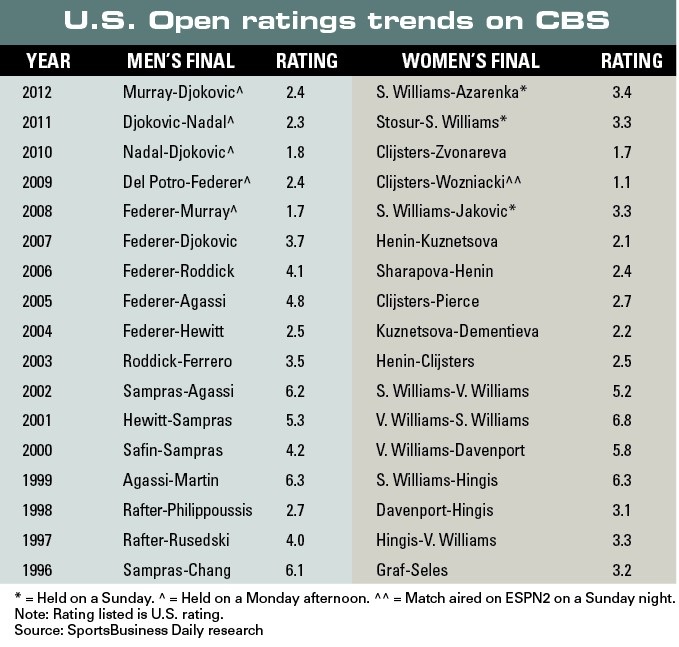
The start of fall for many means a doubleheader on CBS Sports on the first Sunday after Labor Day: an NFL season-opening game followed by the men’s U.S. Open final. While rain delays have disrupted that routine in recent years, CBS, with its 40 years of broadcasting the Open, has made an indelible mark on TV culture.
CBS has broadcast the U.S. Open for 40 years.
Photo by: Getty Images
But ESPN’s power and money talk, and for $80 million a year, starting in 2015, the sports giant will have the entire tournament (it currently shares the event with CBS and Tennis Channel). CBS will lose the Labor Day weekend and the finals weekend, and from first ball strike to last, it will be largely ESPN’s event (Tennis Channel retains some rights).
The U.S. Open follows other events like Wimbledon and the British Open that have migrated off broadcast to full cable. That means losing the 15 percent to 20 percent of the TV-watching universe that does not have cable, but the USTA is not concerned.
“We will be at the center of American sports culture for the next decade or more,” said USTA Executive Director Gordon Smith.
Those who don’t subscribe to cable will lose one other option for event coverage. The USTA has streamed for free all TV court matches during the event at USOpen.org. Starting in 2015, however, the site will have a link to the watchESPN app, which is available only to those with a cable subscriber that carries ESPN. USTA members will also have access.